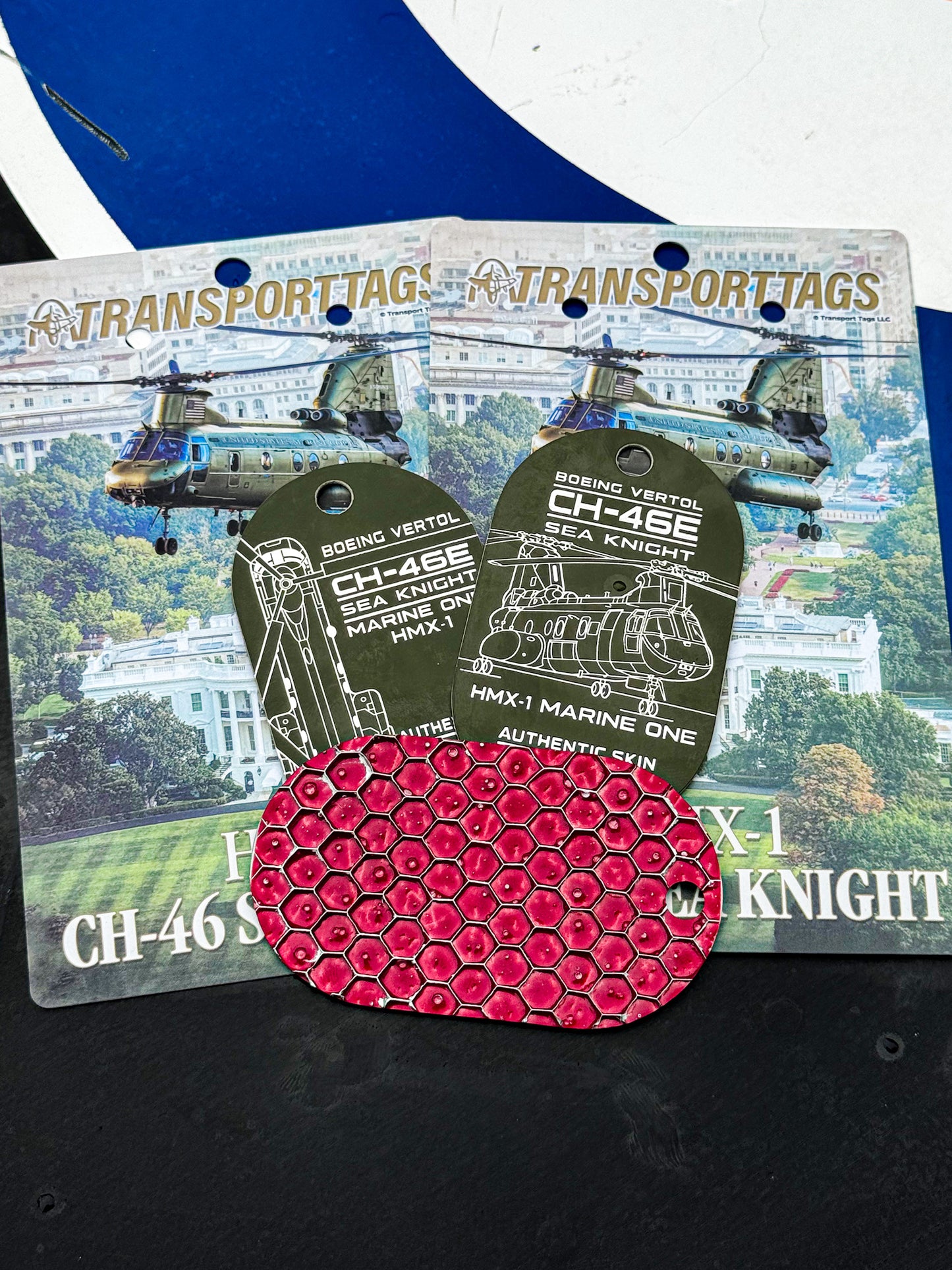
Marine One CH-46 Sea Knight
Marine One CH-46 Sea Knight
Couldn't load pickup availability

Pictured: Our Marine One CH-46 Sea Knight at Joint Base Andrews 22 May 1992. Photo Credit: Paul Seymour
Our Sea Knight, CH-46E BuNo: 157683 was constructed as a CH-46F (construction number 2582) and was accepted on February 16, 1970. ’683 began her service with the renowned HMX-1 “Nighthawks” starting on May 22, 1970. This marked the beginning of a distinguished career throughout eight presidential administrations—from President Nixon to flying President Barack Obama on occasion, earning the Marine One title.

Pictured: Daniel W. Bissell, James Clark Bissell and Leonardo Parra, DaVinci Aircraft
Prior to 2014, HMX-1’s mission included both presidential transport and operational test and evaluation (OT&E). ’683 was known to have supported OT&E missions, most notably at the Naval Air Test Center (NATC) at NAS Patuxent River during a stint from January 23, 1973, to March 13, 1973. She also performed routine OT&E missions at MCAS Quantico, evaluating helicopter tactics.
HMX-1 Phrogs also supported the Marine Corps Combat Development Command (MCCDC). These Sea Knights took part in helicopter familiarization training for Marine personnel and were a vital part of advanced instruction programs such as fast-roping operations, as well as training exercises at MCCDC’s “Combat Town,” where assault teams rehearsed hostage rescue missions. ’683 was most likely a vital part of this instrumental training program, having been a career HMX-1 bird.
’683 most often flew support missions alongside the white-top Marine One VH-3, traveling alongside the President carrying vital staff and equipment necessary to facilitate logistics in safely transporting the President of the United States. ’683 also often carried White House staff, Secret Service agents, VIPs, and members of the press. She also featured a unique VIP conversion kit for specialized transport. While not the standard white-top VH-3D commonly associated with being Marine One, other HMX-1 aircraft have transported presidents on certain routes, including Camp David to Andrews AFB and Dulles. Our CH-46E fell into this unique category, and famously accompanied President Obama on a UK trip in 2011.
’683 was one of the 275 Sea Knights that were eventually upgraded to a CH-46E, receiving an enhanced avionics package, improved hydraulics and drivetrain, and upgraded General Electric T58-GE-16 turboshaft engines.
DaVinci Aircraft provided us information that featured ’683 notably carrying President Obama to and from Camp David on non‑White House routes on numerous occasions. With ’683’s lengthy HMX-1 tenure, it is entirely likely that she carried numerous other presidents, including Nixon and Reagan.
By the mid-2010s, the aging CH-46Es were gradually phased out of HMX-1 service and replaced by the V-22 Osprey, in which presidents are barred from ever flying on, so they’re strictly used in the support role, unlike the HMX-1 CH-46s occasionally having a president aboard. ’683 was eventually transferred to the U.S. Department of State and registered as N683WR in 2014, before being acquired by DaVinci Aircraft, Inc., which plans to transform the helicopter into an aerial firefighting platform, ensuring the aircraft’s legacy continues in a new mission. In 2025, we partnered with Leonardo Parra, CEO of DaVinci Aircraft, Inc., to acquire the original rear ramp door from ’683, which we subsequently preserved in the form of TransportTags. We are proud to offer this unique piece of presidential aviation and Marine Corps history, allowing collectors and aviation enthusiasts to own a tangible connection to the operational legacy of the CH-46 Sea Knight, HMX-1, and presidential transport operations.
(Please note that Transport Tags LLC is not an authorized or licensed distributor of Boeing, Vertol, or any of their affiliates. All Boeing/Vertol names, aircraft designations, markings, logos, and other intellectual property are used solely for identification and descriptive purposes in accordance with the Lanham Act. This product is crafted from genuine surplus military hardware and is not affiliated with, sponsored by, or endorsed by the US Military or the Department of Defense.)
Vehicle History
Vehicle History
CH-46 Sea Knight: Maker and Development
The CH-46 Sea Knight was developed by Vertol Aircraft Corporation, which became Boeing Vertol after its 1960 acquisition by Boeing. Building on Vertol’s successful tandem-rotor designs like the H-21 “Flying Banana,” engineers created the Model 107 (military designation V-107) in the late 1950s to meet the U.S. military’s need for a modern medium-lift transport helicopter. The prototype first flew on April 22, 1958, featuring two powerful General Electric T58 turboshaft engines driving overlapping tandem rotors, a spacious fuselage with a rear loading ramp, and an amphibious hull for water operations. After rigorous testing and competition wins, the improved CH-46A entered service with the U.S. Marine Corps in 1964, quickly proving its value in troop transport, cargo lifting, and medevac roles.
Subsequent variants like the CH-46E and F incorporated upgraded engines, avionics, and structural reinforcements to handle demanding combat environments from Vietnam through the Gulf Wars. Production totaled around 524 aircraft, with the Sea Knight earning the affectionate nickname “Phrog” for its distinctive profile and reliability. It served as a workhorse for over five decades before final retirement in 2015, replaced by the MV-22 Osprey. Its robust tandem-rotor system and versatile design made it a cornerstone of Marine aviation, with select examples even supporting high-profile missions in presidential transport configurations.
Product Specifics
Product Specifics
Vehicle Stats
Vehicle Stats
Key Specifications (CH-46E Variant)
• Manufacturer: Boeing Vertol (later Boeing Helicopters)
• First Flight: April 22, 1958 (as Model 107/V-107)
• Introduction: 1964
• Retired: 2015 (U.S. Marine Corps)
• Number Built: Approximately 524
• Crew: 3–5 (2 pilots, crew chief, gunners/observers)
• Capacity: Up to 24 troops, 15 stretchers with attendants, or ~5,000–7,000 lbs (2,268–3,175 kg) of cargo
• Dimensions:
• Fuselage Length: 44 ft 10 in (13.67 m)
• Overall Length (rotors turning): ~83 ft 4 in (25.40 m)
• Rotor Diameter (each): 50 ft (15.24 m)
• Height: 16 ft 9 in (5.11 m)
• Weights:
• Empty: ~15,537 lbs (7,047 kg)
• Gross/Max Takeoff: 24,300 lbs (11,022 kg)
• Powerplant: 2 × General Electric T58-GE-16 turboshaft engines, 1,870 shp (1,390 kW) each
• Performance:
• Maximum Speed: 166 mph (267 km/h)
• Cruise Speed: ~143–165 mph (230–265 km/h)
• Service Ceiling: 17,000 ft (5,181 m)
• Range: ~550–633 miles (885–1,020 km) depending on configuration and load
• Climb Rate: ~1,300–2,000 ft/min
Design Highlights
• Tandem Rotors: Iconic overlapping rotors provide excellent lift, stability, and redundancy (one engine can power both rotors in emergencies).
• Rear Ramp: Allows rapid troop/cargo loading and unloading, even in flight.
• Amphibious Capability: Hull design supports water landings.
• Upgrades (E/F models): Improved engines, avionics, hydraulics for better performance in hot/high conditions.
Product Dimensions
Product Dimensions
Disclaimer
Disclaimer
TransportTags are unique, handcrafted pieces made from genuine vehicle skin. Features like scratches, blemishes, or minor discolorations testify to their unique vintage appeal and authenticity. By purchasing, you accept the product may differ slightly from website images. Transport Tags LLC uses authentic material from transportation vehicles, potential containing hazardous substances. Not intended for ingestion, inhalation, or use by small children. Transport Tags LLC is an independent company, not affiliated with, sponsored or endorsed by any entities. We use branded names and insignia for identification under the provisions of the Lanham Act, without implying any association or endorsement. For more information, read our detailed product safety and legal information here.